Thursday, March 13, 2014

A day of major change and progress


The 13th of March.  I am convinced that I am healthy.
I've extended my stay in Timor Leste by 12 days. 
We finally received the seismic equipment.

I was uncertain about extending my stay given the possibility of serious illness and endless hangups with customs.  Nonetheless, it seemed to be worthwhile to assume these things would work out, and accordingly, take advantage of being here with equipment in hand.  I one day I have ranged from nearly complete uncertainty to the ambitious goal of installing most of the equipment.  Here is a rundown of the day:

7am - wake up feeling well
8am - arrive at the Timor Plaza shopping mall to change my flight(s)
9am - was not successful changing flight home from Bali
9:10am - freak out and email the Banda Arc crew at USC, then get cut off from internet access
9:20-10:20am - change my flight from Dili to Bali, assume that the rest will work out
11am - get back to IPG to see if my assumption was valid...don't find out because the power was out
12pm - find out that Josh West took care of it all, all travel arrangements set
2pm - go to collect equipment
4pm - arrive back at IPG, triumphantly
4:30-6:30pm - test half of the equipment pool to see if all is ready for deployment

 
Testing the last set of equipment for the day.  Seismometer on left, data recorder in middle, battery on right.

The equipment I tested seems to have survived the journey here.  We plan to deploy 3 sites in the next 2-3 days and push on next week.  The first install will be very telling - there are always unanticipated problems.  The only certainty I have, based my equipment test runs, is that I will perspire well beyond the saturation point of my clothing.  Seriously, if there was a way to harness this and send it back to California, all our drought issues would be solved.

My clothing was originally light blue and light grey.

Tuesday, March 11, 2014

A fever for Timor Leste

I must admit, back in the states I do what I can to avoid trips to the doctor.  I try to live a healthy life, and fight my way through sickness without medicine.  When abroad, I am exceptionally thankful for western medicine. 
I came down with a fever a few days ago, along with cold-like symptoms.  I rode it out for a while, but after looking at a few medical pages online I decided that it would be best to visit a medical clinic.  Stamford Medical Ltd. in Dili was founded in 2013, and hosts a full range of services.  They provide medical care in 15+ languages.  It wasn't particularly easy to find the place via taxi, but we eventually made it.

The sign from outside.
 
After the first night of strong fever symptoms, I thought it was worth waiting through another day to see how things progressed.  The next day and night were still uncomfortable, but not as bad.  But still bad enough to go into the clinic this morning.  Dr. Christiane Pfeiffer-Pinto performed her analysis and revealed some interesting information.  She has observed a strong decline in the number of malaria cases in her 10 years in Timor Leste, and recommends that those who stay here for long-term periods do not need to take prophylactics to protect against the malaria parasite.  However, Dengue Fever is much more common.  My bloodworks suggests that I have a virus, but is more consistent with a flu than Dengue because I am not afflicted with body pain, nausea, or vomiting.  The next few days will be telling, and if my health does not improve, it could be Dengue.  Good times.
 
Overall, this is somewhat relieving because it seems that I have a flu.  I can't say I have ever hoped to have the flu, but I do now.  

Downpour


When it rains here, it rains HARD.  I shot this short video at night so the rain can be seen.  It is still the wet season here, and will be until sometime in July.  These storms take place about once a day.

Monday, March 10, 2014

Reverse engineering the customs process

I admit that I don't have much experience with the procedures of international customs.  During previous projects, it was clear that navigating the importation of goods is quite complicated.  Back at USC, I spent much time maintaining and upgrading our beloved seismic equipment.  When it was clear that the trip to Timor Leste was on, I put together the shipping invoice and international shipping documents.  For a county under development such as Timor Leste, the resources online are not exactly complete.  I found that our shipment would be exempt from import tax if our project was associated with a government entity, and is meant for scientific research.  Great, so then there should be not problem, right?  Fellow postdoc Rob Porritt and Ph.D. student Cooper Harris packed the equipment onto the FedEx truck while I was on my way to the airport.  Things were on their way.

The equipment leaving USC, geophysicists for scale.
 
I arrived in Dili on the 26th of February and the equipment was scheduled to arrive 2 days later.  Those 2 days came, and the shipment was still in Singapore.  Not yet time for panic.  Monday came around, and we found that the equipment had arrived in Dili.  We went to the airport to the FedEx office, and they redirected us to the Timor Leste partner, SDV Logistics, who handles the import.  We made it to the SDV office to find out that the equipment is being held and we were given two options: pay a 10% import tax (on the declared $50,000 value) and get the equipment in 3 days, or wait a week to have the equipment released without charge.  I don't think the second option was actually available, and the first was certainly not in our budget.  Arrrrgh.

So we continue on with the process, first by obtaining a letter from IPG's administration declaring that the shipment was meant for a government-hosted scientific research project.  That took a few days to get a hold of.  We delivered this letter to the customs office to get things moving.  At this point, we left Dili for the aforementioned field days.  Once we made it back to Dili and revisited the customs office, it was clear that no further progress was made.  I urged Eugenio to push on them to make this happen, and he did.  The letter we delivered was sent back and forth between divisions within customs, and was finally on the desk of "Mr. Alex," who is responsible for judging the application of customs procedural process.  I felt sure that if we didn't visit the office and give some push, nothing would've happened.  It was judged that our shipment was indeed exempt from import tax, and our paperwork was ushered on to the next level.  At this stage, we were one level from the top of the customs ministry.  They needed to write a final endorsement before sending it on to the minister of customs.  The next day, Eugenio visited the customs office and found that the letter was delivered to the customs minister.  This gave us the proper documentation to visit the SDV Logistics office again to demonstrate that things were in order.  After a long conversation with the importing agent, we were assured that the equipment will be released within 24 hours. 

So it is clear in hindsight - we should have obtained the government endorsement prior to shipping and included this with the import.  But we could not get the endorsement letter without having our MoU signed.  I proceeded in exactly the opposite order, ship equipment, then have letter written, then sign MoU. Reverse engineering at its finest!

Update coming soon...

The sign for the Customs and Import office.  I hope to never see this again.
 

Sunday, March 9, 2014

Second day of field work


We set off to the west and then south to the country's thirds most populous city, Maliana.  This is Eugenio's home town and he already has an inside track on a site.  He is gracious enough to drive his own vehicle.  We also bring an IPG staff member, Bela.  She was educated in Indonesia, and will be working with us throughout the project.  We set out to the west along the coastline along similar conditions to what I describe in a previous post.  There is one exception: a ~10 km section of road that is perfectly smooth, complete with signage and road markings.  It feels out of place, but is hopefully and indication of things to come for Timor Leste.  This is the main road connecting Dili to the Indonesian portion of Timor. 

The route from Dili to Maliana.

We stop along the way for some lunch.  This is the first time I tested my western stomach against truly local food.  All previous meals have been born out of supermarket food, the hotel I am staying at, and a few restaurants.  We first bought some steamed corn cobs.  The kernels are sparse, there are divisions between the rows, and the flavor is mildly sweet and starchy.  I couldn't help but think that this is as far removed from GMO corn that we see in the states as possible.  Maybe I am over-analyzing it, but since I have been with my Wisconsin-born wife, I have a better appreciation for corn!
That was just a starter...we stopped in at a hut on the side of the road.  Lunch consisted of two items, rice soaked with coconut juice all wrapped in a matrix of coconut leaves and barbequed fish that was caught in the morning.  Completely simple, but full of delicious goodness.  I was hesitant since both of these treats were no longer warm, but I figured it was time to roll the dice.  As I write this (~40 hours later), I can say that my system seems to be fine.  Progress! I most certainly took in some new members to the gastrointestinal system.

Delicious.

A view of the beach from this lunch spot.

We moved on along the coast to the west and headed south when the road met the border of Indonesia.  The traverse inland is quite rugged, and stretches across the Bobonaro complex, and group of limestone rocks that are quite susceptible to landsliding.  Fortunately, being from northern California, I am accustomed to failing slopes and broken roads - so, no problem.  Except that in Timor Leste, there is not a major world economy to rebuild...
We arrived in Maliana to take in the impressive landscape.  Most of the city is build upon a vast sedimentary plain that was constructed along the confluence of two large river systems.  To the east and south, this plain gives way to an impressive topographic rise - not a surprise given the active tectonic character of the entire island!  This is why we are here.  Eugenio phones in his two contacts for possible site locations and we visit both.  The first is at a local health clinic, but doesn't work because it is out in the sediment plain and I suspect that this site is also susceptible to flooding.  This is a good opportunity to discuss with Eugenio and Bela the problem with installing a seismic station on a thick sedimentary formation; it doesn't allow the transmission of the complete seismic signal of an earthquake. 


A view from a rice paddy in Maliana looking at a 1200 m rise to the surrounding mountains.


On to the next site, the district Administrator building.  Eugenio is close friends with the deputy administrator, and we already are in.  The site is not perfect as it is still within the sediment plain - but because it is on the edge of the plain, I judge that it will work.  Most importantly, it will be a safe location for our equipment. 

The Maliana Admin complex.  The site will go in along the back wall in the distance.

Before we headed back to Dili, we stopped in a Eugenio's family home.  This is where he grew up and lived until he left for his education.  His father runs a construction company, something that I have in common with him.  More interestingly, his father was the King of the region earlier in life, taking over as King from Eugenio's grandfather.  That system gave way to Indonesian authority in the 1960s...what a great story!  I was honored to be the first American to visit. 

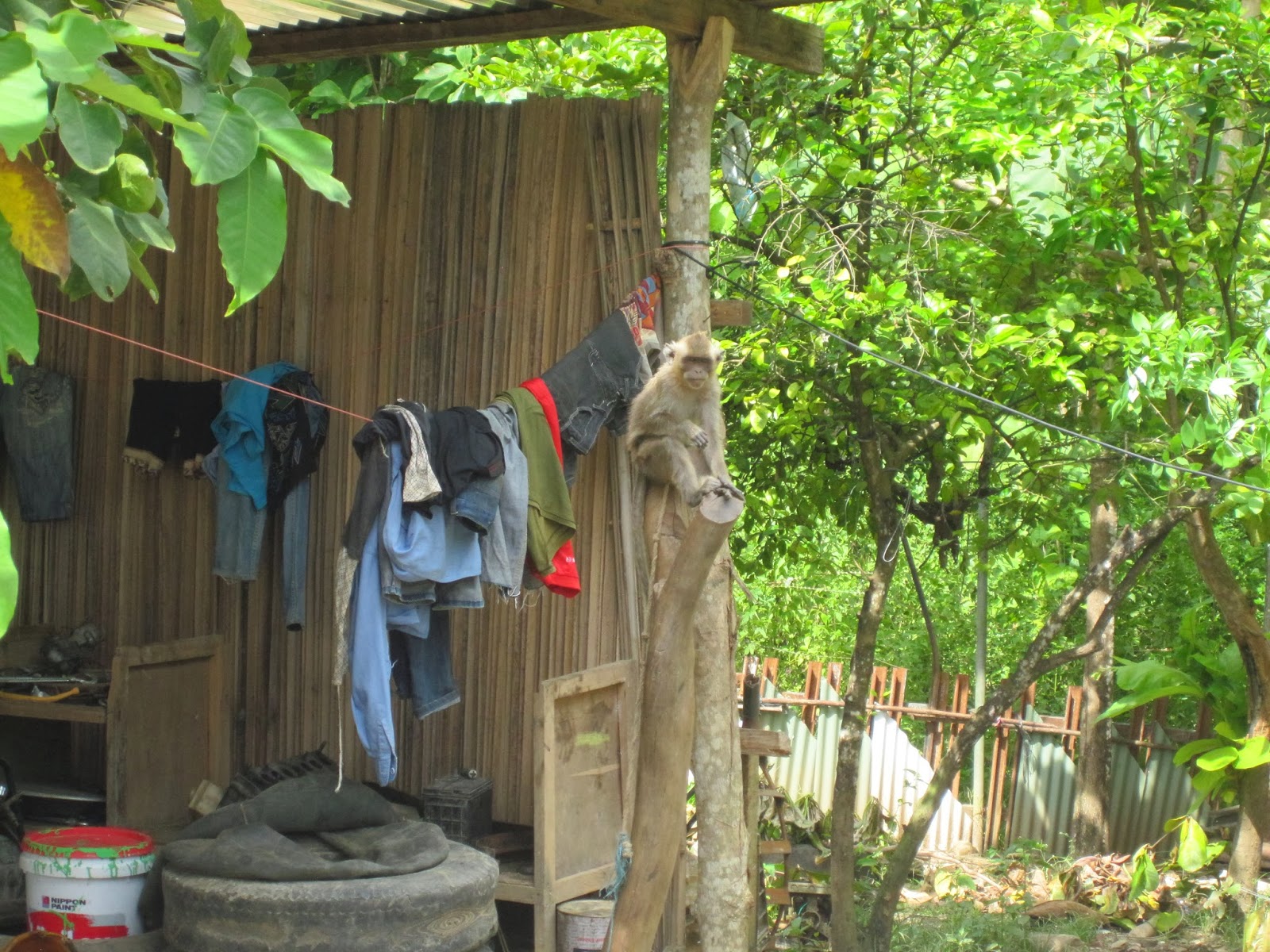
A pet monkey.

Two pet raptors to keep the monkey company.


The return trip was another dose of road peril, but highlighted by an beautiful view of the sunset along the northern coast.  I continue to be entertained by being in the southern hemisphere - the sun and moon traverse the northern sky.  Really though, being near the equator, the sun traverses overhead.  When it sets over the humid Savu Sea, it produces a spectacular sunset.  There will be many more of these moments to come.

The beginning of a spectacular show.


Another day in Dili


Half the day was spent at IPG trying to sort out custom issues and the other half finding a location near Dili for a station.  We travelled to the south about 15 minutes climbing to the small village of Dare.  We are there to visit a Catholic church and talk with the Pastor.  It was along this traverse that the first photo I posted was taken.  The church grounds are especially peaceful.  There is a small school with children between 8-12 years of age.  The site should work, but we need to return to Dili to speak with the Pastor.  We find him in Dili, he is on board, but wants to pass it by the national Bishop.  This may be a good thing for the sake of other locations on church grounds.

The church grounds. A peaceful place.


Field work finally begins


3rd of March.  My first opportunity to leave Dili and make progress in the field.  I head east with director Eugenio Soares and driver "Alex" in IPG's gold Land Rover.  Quick note: This is my first time in a country that drives on left-hand side of road...cool.  We are setting off to deliver letters of endorsement to the Administrators of the Baucau and Los Palos districts.  We visit the cities of the same names. 
The route from Dili to Baucau to Los Palos

I quickly learn that traveling through the country will always be a harrowing experience.  The roads are narrow, just wide enough to squeeze to car widths in.  The roads are rough...very rough.  Traffic is a mix of slow moving motorbikes, fast and slow moving microbuses, slow moving haul trucks, and fast moving SUV/truck vehicles (including our Land Rover).  The roads vary from occasional stretches of straight runs to endless hairpin turn sections.  Within a few meters of the road are villages, the ocean, lagoons, pigs, goats, cows, dogs, people, hand-carts, rocks, etc. 
A typical house along the road.

A microlet minibus traversing the road.  The inside is also full of passengers.

Trying to make our way around a truck.

I am wondering if we will survive...

The driver set out at a furious pace.  I apologize to my wife for not protesting immediately.  When a free stretch of road is available, the driver accelerates to 100 km/hr and doesn't consider slowing until well into the upcoming blind corner.  When in the hairpins, acceleration and rapid braking are the only options.  Weaving between kids and animals that flank the road is done without slowing, aided by riding the horn to alert of the impending doom.  Ok, maybe I am being a bit melodramatic here, but I am reflecting my true experience in the moment. 

We arrive in Baucau, the second most populus city in the country.  As will all other portions of the traverse, there are no signs indicating direction or destination anywhere.  But no problem, just stop and ask!  We arrive just after noon, and find that the district Admin will be back from lunch at 2pm.  We must wait it out because it will take too long to go on to the next stop and make it back by the end of the work day.  After a $2 fried noodle lunch and some down time, Eugenio and I are in the Admin's office.  In their language, Tetum, Eugenio delivers the goods: he gives the same presentation I gave to the Minister a few days ago.  I sit there and listen while recognizing the general flow of the conversation.  Truely, they speak a mixture of Tetum and Portugese, and my knowledge of Spanish is semi-relevant.  I am drenched in sweat during the whole meeting, trying not to deliver a mixed message of nervousness! It goes well and they agree to locate possible sites for immediate installation. Check.

The sign at the entry of the Baucau Admin complex.


On to Los Palos.  We have a few hours to get there.  Across another coastal stretch and then an ascent through lush tropical foliage through a torrential rain.  This is clearly a different microclimate in comparison to the region around Dili.  We emerge on top of a flat, open plain that hosts the Los Palos district.  Los Palos is sparsely populated, and nearly all houses and buildings are right along the road.  We arrive at the Administrator's building, the largest in the area, and check in with security.  There is a handful of men watching what seems to be a bizarre Japanese game show on TV.  We shake some hands and greet them all and the Admin is informed of our arrival.  There are some photos of local flora and fauna on the wall and I take not of a warning of neon green colored Pit Viper snake.  It is a beautiful creature, and I expect to see one at some point in the future.  Mental note: ALWAYS sweep a field site before digging in to work! 
Again, Eugenio delivers the goods, and this Admin is quite interested in the science.  He keeps saying "terremoto" and Eugenio is confused, thinking that he means 'seismometer.'  Terremoto is Spanish/Portugese for "Earthquake."  I later learn the Tetum way to say earthquake: Rrai nacodoco.  It literally means 'earth shake' and is it fun to say...make sure to roll the 'r' in rrai.  It is agreed that we will install the station on the grounds of the Admin building as it is the only safe place to install it in the area. Check.

It is 5pm, and time for the 6+ hour drive back.  Since we are near the equator, there is 12 hours of sunlight every day, so it is light until 7.  That is when I find out that the Land Rover has pitiful headlights.  The high beams are almost as good as normal lights.  To further complicate the matter, drivers communicate by flashing each other with variable patterns.  This adds some more time to the trip home.  I am VERY happy when the long day is over.